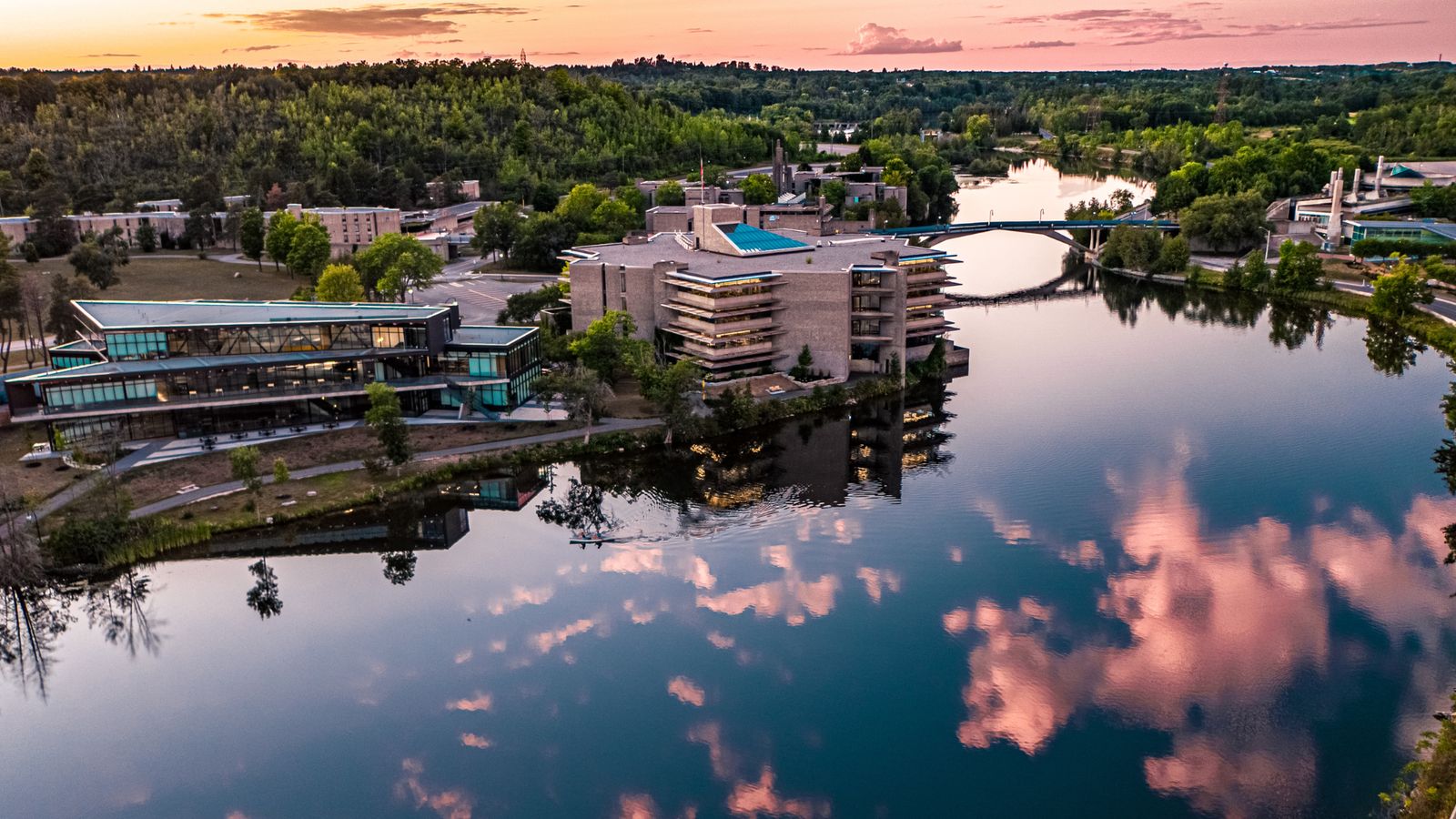
Bata Library and the Chemical Sciences Building on the Otonabee River at sunset

Understanding chemical transformations in the environment to predict their impacts and design safer chemicals and cleaner water

The Sullivan Lab is moving to Trent University in January 2027. We are recruiting undergraduate and graduate students, postdoctoral associates, and a lab manager.

Open positions

A new research program at Trent University

Ryan Sullivan is moving the research group to Trent University in Peterborough, Ontario, Canada, in January 2027. He will hold the Eddie Goldenberg Research Chair of Canada in Environmental and Sustainable Chemistry, with appointments in the Department of Chemistry and the Trent School of the Environment. The Chair provides $8 million over eight years to build and support a world-class research program, and the Canada Foundation for Innovation provides a further $4 million for infrastructure, facilities, and research equipment. Read Trent's announcement.

Research

The group studies how chemicals transform in the environment at the molecular level, and uses that understanding to design safer chemicals and new water treatment technologies. A mechanistic focus links our four research themes: we determine reaction mechanisms, kinetics, and transformation products directly, often in single particles and droplets and at interfaces, where chemistry differs sharply from that in bulk solution.

Atmospheric chemistry

Wildfire smoke chemistry, aerosol–cloud–climate interactions, and the multiphase chemistry of individual aerosol particles: how reactive uptake of trace gases alters particle phase and morphology, and how those changes feed back on chemical reactivity.

Photochemistry and transformation products

Aqueous photochemistry, photosensitization, and transformation products, to predict how synthetic chemicals transform and persist in the environment.

Sustainable chemistry

Safer chemical design: assessing the hazards of new chemicals and their transformation products before large-scale production.

Water treatment and reuse

Contaminant remediation chemistry, including technologies that destroy persistent organic contaminants through aerosol-accelerated chemistry.

Across all four themes, we ask what reactions occur, which reactants drive them, how fast they proceed, and what transformation products form.

Read more about our work

Approaches

Our main experimental and computational approaches include:

Group members build and adapt instruments rather than only operate them, and combine experiments with computational modelling across chemistry, environmental science, and engineering.

The Water Quality Centre laboratory seen through its glass wall, with rows of mass spectrometers
The Water Quality Centre, the most comprehensive mass spectrometry facility in Canada. Photo: Trent University.
Trent University's Chemical Sciences Building at dusk, reflected in the Otonabee River
The Chemical Sciences Building, home of the Department of Chemistry and the Water Quality Centre. Photo courtesy of Teeple Architects.

Videos

Removing PFAS molecules using ultraviolet light (2023)
Studying atmospheric particles using aerosol optical tweezers (2019)

Principal investigator

Ryan C. Sullivan

Eddie Goldenberg Research Chair of Canada in Environmental and Sustainable Chemistry
Department of Chemistry and Trent School of the Environment, Trent University

Ryan Sullivan joins Trent University in January 2027 from Carnegie Mellon University, where he was on the faculty from 2012 to 2026 as Professor of Chemistry and Mechanical Engineering, with a courtesy appointment in Civil and Environmental Engineering.
At Carnegie Mellon, he was also the Associate Director of the Institute for Green Science, the Director of Graduate Studies for the Department of Chemistry, and Core Faculty in the Environmental & Sustainability Studies interdisciplinary program.

Trent University and Peterborough

Trent University is widely recognized for its strengths in interdisciplinary environmental research and education. Its Water Quality Centre and Canadian Environmental Modelling Centre give the group direct access to advanced mass spectrometry and chemical fate modelling.
Peterborough sits in the Kawartha Lakes region of central Ontario, with 134 lakes nearby. The Symons Campus spans both banks of the Otonabee River, part of the Trent–Severn Waterway, and the Rotary Greenway Trail links campus to downtown Peterborough.

Peterborough is about 90 minutes by car from Toronto and about 1 hour 40 minutes from Toronto Pearson International Airport. Ottawa is three hours away and Montreal five. GO buses run from campus 12 times a day and connect with GO trains to Toronto’s Union Station at Oshawa, and FlixBus runs direct to Pearson. Living costs, especially rents, are lower than in Toronto.

Aerial view of Trent University's Symons Campus and the Otonabee River
Trent University's Symons Campus on the Otonabee River. Photo: Trent University.
Trent University in Peterborough, Ontario. Select the map to open it in Google Maps. Map: Google.

Join us

New group members will join us at Trent University, where we move in January 2027. We are recruiting undergraduate research students, MSc and PhD students, postdoctoral associates, and a lab manager, with positions starting as early as February 2027.

Undergraduate students

Trent undergraduates in chemistry, environmental science, and related programs can join the group for honours thesis research (CHEM 4010Y), summer research positions including NSERC Undergraduate Student Research Awards, and paid work terms through Trent’s Chemistry and Forensic Chemistry co-op programs. Undergraduates work on their own projects alongside graduate students and postdocs.

Undergraduates do not use the application form below. To discuss research opportunities, talk with your program director and email Prof. Ryan Sullivan.

Graduate students (MSc and PhD)

We welcome students from chemistry, physics, engineering, and environmental science who are curious about how reactions work, and we train students in the instruments and methods described above.

Students enroll through Trent's Environmental and Life Sciences or Materials Science graduate programs. Students begin in the MSc unless they already hold one, and MSc students can transfer to the PhD. Trent requires a confirmed supervisor before you apply to the graduate program, so start with our application form below. Trent's application deadline for September 2027 entry is February 1, 2027.

We also host co-op work terms for students in Trent’s Master of Instrumental Chemical Analysis program.

Postdoctoral associates

We seek at least two postdoctoral associates who want to understand how and why chemicals transform in the environment, and to use that understanding to design safer chemicals and better water treatment technologies. We welcome applicants from chemistry, chemical and environmental engineering, physical chemistry, and related fields, including people new to environmental systems.

Requirements

Applicants need a PhD completed within the last seven years, or by the start date. Their research should involve reaction kinetics, mechanisms, or transformation products; photochemistry; water treatment chemistry or process engineering; or the physical chemistry of single particles, droplets, or interfaces.

Expertise we value

We value deep hands-on expertise in at least one of these areas:

  • Water treatment chemistry and engineering, including reactor design, scale-up, and process modelling
  • Droplet microfluidics, including device design, fabrication, and flow control
  • Building or adapting instruments, such as particle traps, laser spectroscopy, or mass spectrometry inlets and ionization sources
  • High-resolution mass spectrometry with nontarget analysis to identify unknown products
  • Time-resolved or interfacial spectroscopy
  • Computational chemistry applied to reaction mechanisms

Experience with both aqueous and atmospheric systems, fellowship or grant writing, mentoring students, and quantitative data analysis and programming are all assets.

What we look for

Much environmental chemistry centres on measuring composition, concentrations, or physical properties. That work is valuable. In this group, though, we want people whose skills reach the next question: what reaction is occurring, which reactants drive it, how fast, and what products form, or how to engineer a process or device that controls it. If your background is mainly measurement-focused but includes kinetic, mechanistic, or engineering work, tell us about that part.

The start date is as early as February 2027. These are existing vacancies.

Lab manager

The lab manager runs the day-to-day operation of a new laboratory and helps set it up during 2027. Duties include operating, maintaining, and developing methods on the group's liquid chromatography–mass spectrometry (LC-MS) systems, which include a triple quadrupole for quantitation and a high-resolution instrument. The lab manager also prepares samples, trains students and postdocs on the instruments and in laboratory safety, and manages purchasing, inventory, chemical safety, and waste. The role supports instrument installation and data management.

This is a staff position for applicants with a BSc and at least two years of relevant hands-on experience, or an MSc, in chemistry, environmental chemistry, or a related field. Applicants need substantial hands-on experience with LC-MS/MS: method development, quantitation, quality assurance, troubleshooting, and routine maintenance. GC-MS, nontarget analysis workflows, autosamplers and laboratory automation, and prior laboratory management or safety coordination are assets. SCIEX instruments and software are also an asset.

The start date is as early as February 2027. This is an existing vacancy.

Scenes from Trent University's Symons Campus. Video: Trent University.

How to apply

  1. Complete our application form and upload your CV as a PDF. The form takes about 20 minutes. It asks about your research experience, the techniques you have used, and one research question you worked on at the molecular level.
  2. We invite selected applicants to submit a full application and to interview. We contact referees only at this stage.
  3. Graduate students we accept then apply to Trent University's graduate program, with Ryan Sullivan as supervisor.

We review applications on a rolling basis, beginning in December 2026, until the positions are filled. The form is the only way to apply for graduate, postdoctoral, and lab manager positions; we cannot reply to individual emails about these positions.

The application form will be posted here soon.